Why Founders Can't Finish What They Start (It's Not About Capability)
May 25, 2026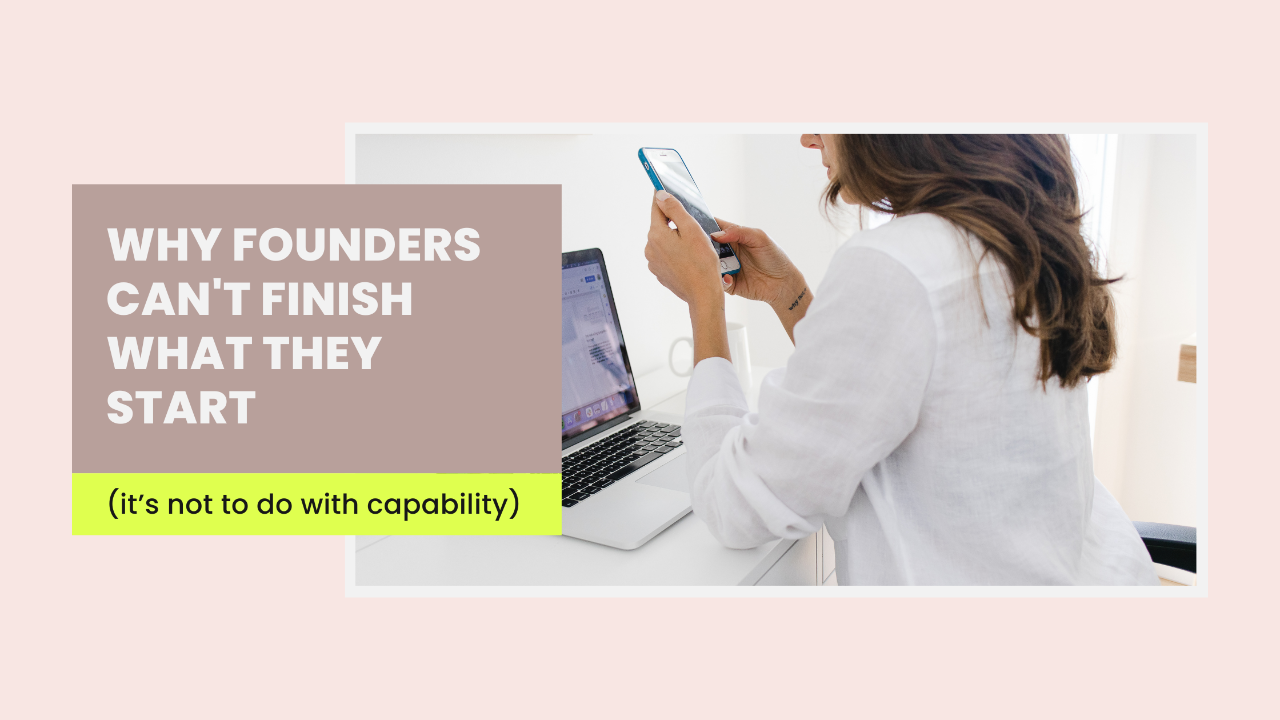
Why founders start everything, finish nothing — and feel terrible about it.
Quick Answer
When a founder can't finish what they start, it's not a capability problem. It's your nervous system in a survival pattern — what I call a fear loop.
A fear loop is triggered by a thought, a belief, your past, or something in your environment. When you're triggered — often without realising it — you enter a reactive or shutdown state. Your nervous system does this to keep you safe from perceived danger.
For founders, fear loops often start when you don't have enough capacity in your system and a thought lands like: "Will my business even work?" or "They're more successful than me — there's no way I can achieve that."
Then...
It shows up two ways:
- You start ten things and finish none of them
- You never start the hard thing at all
Both patterns have the same cause. Both have the same fix.
Sound familiar?
You've answered every email. Your admin is done. You've started three new projects this week.
The sales page still isn't written. The rate conversation still hasn't happened. The offer you've been meaning to send out — it's been sitting half-finished for three months.
You're exhausted. You worked all day. But you know nothing really moved.
That guilt — "why can't I just do the thing" — is the signal. You're not incapable. You're in reactive mode. Your nervous system is keeping you busy with things that feel safe, so you never have to attempt the thing that could fail.
What is a fear loop?
A fear loop is when your nervous system uses busyness as a protection strategy. The hard task feels threatening, so your nervous system finds other things to do instead. Things that feel productive but carry no real risk.
Clearing your inbox can't fail. Starting a new project can't fail yet. Answering messages can't tell you something scary about yourself.
The hard task can. So you avoid it — not by sitting still, but by staying constantly, convincingly busy.
Research by Dr. Fuschia Sirois and Dr. Timothy Pychyl confirmed this pattern is about emotion regulation, not time management or capability. The problem is never the task. It's what completing the task might reveal.
What are you actually afraid of?
Fear loops usually run on one of these:
| The fear | What it sounds like |
|---|---|
| Failure | "If I try properly and it doesn't work, I'll have to face what that means about me." |
| Visibility | "If I put it out there, people can judge it — and me." |
| Finding out | "What if I do this properly and it still doesn't work?" |
| Success | "What if it works and I can't sustain it?" |
What the fear loop is costing you
| What you feel | What's actually happening |
|---|---|
| Busy but going nowhere | Income-generating work keeps getting displaced by safe tasks |
| Exhausted for no reason | Unfinished things pile up and drain energy even when nothing got done |
| Like you're not cut out for this | Guilt compounds every day you don't do the hard thing |
| Stuck at the same level | Nothing compounds because nothing gets completed |
How to break the fear loop
Step 1: Name the fear — not the task
Before you try any technique, ask one question:
"What am I afraid will happen if I do this and it doesn't work?"
Get specific. Not "I'm scared." Something like:
- "If I put out this offer and nobody buys it, I'll know the business doesn't work."
- "If I raise my rates and they say no, I'll find out I'm not worth what I want to charge."
- "If I post this and nobody responds, I'll have to sit with feeling invisible."
That sentence is what you're actually avoiding. Once you can name it, you can work with it.
Step 2: Stop the reactive spiral before you start
Reactive mode is a physical state. Closing your email won't switch it off — you need to shift your body first.
Before you sit down to do the hard thing:
- Close everything except the one task
- Do 5 minutes of slow breathing (breathe out longer than you breathe in)
- Or a 10-minute walk — outside if possible
You're not trying to feel perfect. You're trying to come down from the state that's been keeping you reactive.
Step 3: Make the first step smaller than the fear
"Write the sales page" feels enormous because the fear wrapped around it is enormous. The task itself isn't.
Make the step so small it can't trigger the fear:
- Not "write the sales page" — "open the doc and write one line"
- Not "send the rate email" — "draft it and save it. Don't send yet."
- Not "put out the offer" — "write it for your eyes only. Nobody sees it yet."
Each small action that doesn't end badly is evidence. Your nervous system needs evidence that the hard thing is survivable — not motivation to push through.
Step 4: Drop the self-criticism after a bad day
Here's something Dr. Kristin Neff's research confirmed: beating yourself up after a reactive day makes the next one more likely, not less.
The shame spiral — "I'm terrible, I always do this, what's wrong with me" — activates more threat. More threat means more avoidance. More avoidance means more shame.
Noticing what happened without judgment isn't weakness. It's how you actually break the cycle.
Step 5: Plan the exact moment — not just the task
Research shows a simple shift dramatically reduces avoidance. Instead of:
"I'll work on the sales page when I feel ready."
Try:
"On Tuesday at 9am I will open the sales page doc and write for 20 minutes."
Specific time. Specific action. No decision needed in the moment. Your nervous system doesn't have a window to negotiate.
Step 6: Reduce friction before you sit down
The more steps between you and starting, the more chances your nervous system has to route somewhere safer.
- Leave the doc open from the day before
- Work in the same place you've done focused work before
- Phone out of reach — not just face down, out of reach
- Tell one person what you're about to do
Step 7: Don't do this alone
Fear loops are harder to break in isolation. When you're by yourself in reactive mode, there's nothing pulling your nervous system back toward regulated.
Working alongside someone else — even virtually — changes your physiological state. This is called co-regulation. Two calmer nervous systems are genuinely more effective than one activated one. It's not accountability. It's biology.
You don't have to figure this out alone.
The Align to Rise Community is built for founders working on exactly this — people who get that not finishing things isn't a character flaw, who are building their own regulation practices, and who do the work together.
Questions founders ask about this
Q: I'm doing loads — why does it still feel like I'm stuck?
A: Because doing and getting results are not the same thing. Reactive busy-ness — clearing things, starting things, responding to things — creates the feeling of progress without moving the needle. If the hard, slightly scary work keeps getting displaced by everything else, that's the fear loop. You're not incapable. You're occupied with safety tasks.
Q: Does working with other people actually help?
A: Yes — and not just for motivation. When you work alongside someone regulated, your nervous system co-regulates with theirs. Your activation comes down. The hard thing becomes more approachable. It's a physiological effect, not a psychological trick.
Q: I've tried productivity systems. None of them stick. Why?
A: Because a fear loop isn't a systems problem. You can have the most sophisticated productivity setup in the world and a nervous system running on threat will route around it every time. The system isn't what needs fixing.
Q: What does "regulated" mean?
A: It means your nervous system is in a calm, safe state — not in fight-or-flight, not in shutdown. When you're regulated, decisions are clearer, starting things feels less threatening, and you can actually finish what you begin. Regulation is a physical state, not a feeling. You can actively shift into it.
What changes when the fear loop breaks
- The hard things get done. Not because you're more disciplined — because your nervous system stopped routing around them.
- The guilt goes. When you're actually doing the work that matters, the background "why can't I just do the thing" dissolves.
- Being busy feels different. Same hours, different work. The reactive spiral becomes actual progress.
- Results compound. Doing the right thing — even imperfectly — builds. Reactive mode doesn't.