
Overthinking: Why Your Brain Won't Quit and How to Break the Cycle
Jun 10, 2026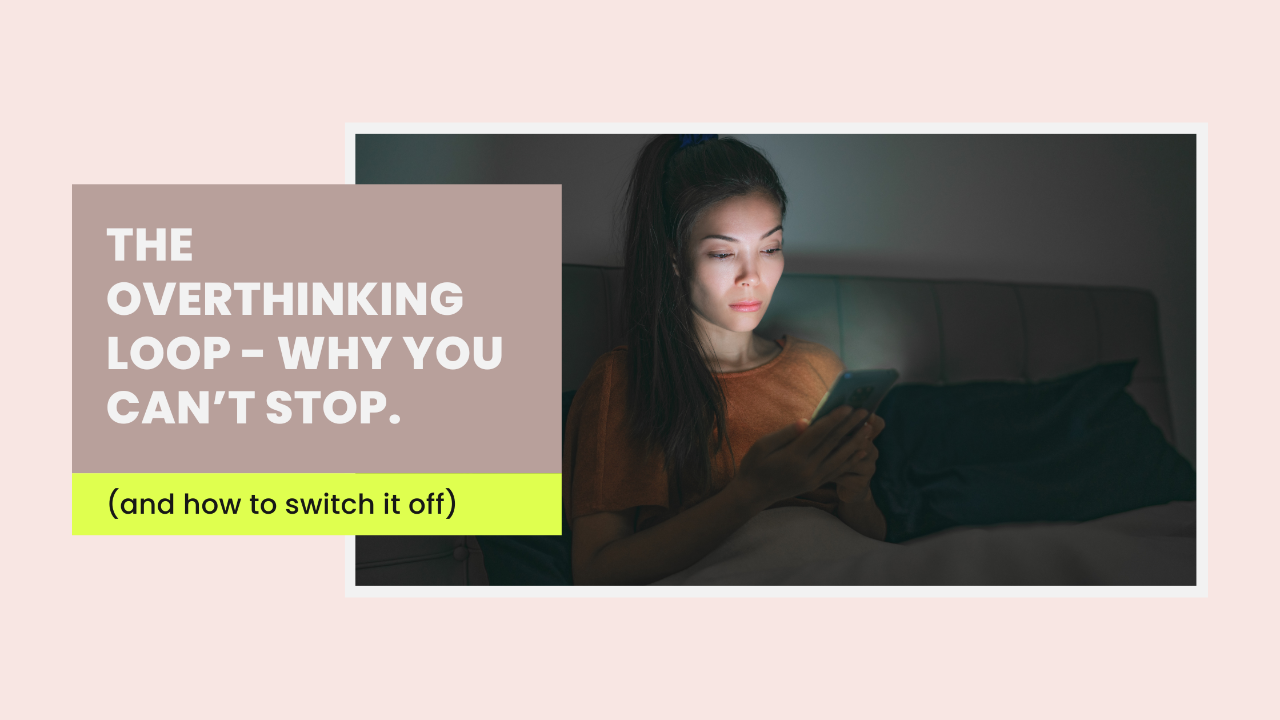
Overthinking isn't just a brain thing. It's a dysregulated nervous system scanning for threats.
Quick Answer
Overthinking is your nervous system in threat-scan mode, cycling through worst-case scenarios in an attempt to find safety. The loop doesn't stop when it finds an answer — it stops when your nervous system feels safe enough to disengage. Until that happens, it keeps running.
Your brain is not broken. It's protecting you from a threat it perceives as real.
What's Actually Happening When You Overthink?
The overthinking loop is not a thinking problem — it's a nervous system regulation problem. When your nervous system detects a threat (real or perceived), it activates the default mode network to run simulations and find the answer that will keep you safe. The problem: if your system doesn't believe it's safe, it keeps looping.
Overthinking differs from productive thinking. According to recent neuropsychology research (Andrews et al., 2024) on rumination and cognitive loops, overthinking is characterized by repetitive cycling on the same concern without reaching new information or resolution. It's not analysis — it's repetition.
The loop looks like this:
- Your system perceives a threat (real or imagined)
- It runs through possible outcomes to find the safe one
- It doesn't find certainty (because certainty doesn't exist)
- It loops back to step 1, running through the same scenarios again
- Each loop feels more urgent because the threat feels more real
How Do I Know If I'm Overthinking or Being Appropriately Thorough?
| Overthinking | Appropriate Analysis |
|---|---|
| Covers the same concern multiple times without new information | Reaches conclusions and moves forward |
| Feels increasingly anxious with each cycle | Feels increasingly clear with each consideration |
| Loops on "what if" scenarios | Evaluates actual information and makes decisions |
| No sense of resolution, just exhaustion | Reaches a decision point and stops |
| Happens outside of active work time | Happens during focused work, then stops |
Quick test: If you've covered the same concern three or more times without reaching a new conclusion, it's a loop, not analysis.
Why Does Overthinking Get Worse At Night?
During the day, task engagement suppresses the default mode network. You're focused on meetings, client work, decisions. The network can't activate because it's suppressed by external task demands.
At night, with nothing to engage it, the network activates. Combined with reduced prefrontal cortex function from fatigue (your brain's rational interruption system is tired), threat simulations run with less rational intervention. According to sleep neuroscience research (Liu et al., 2023), fatigue significantly reduces the brain's capacity to interrupt automatic threat-scanning patterns, which is why the same thought that felt manageable at 2pm feels catastrophic at 11pm.
Can Journalling Help With Overthinking?
Often yes — specifically because it externalises the loop and creates a different relationship with the thought. The key is to write the specific thought, not a general statement about feeling anxious.
Instead of: "I'm feeling anxious about my business."
Write: "I'm worried that if I raise my rates, I'll lose my best client and revenue will drop 40%."
The specificity is what reduces the grip. Your brain can't keep running the same vague loop if you've pinned down the actual fear.
Recent research on expressive writing and anxiety management (Smyth & Pennebaker, 2023) shows that externalising specific concerns reduces their emotional charge and allows the nervous system to move past threat-detection mode, particularly when the written content is specific and concrete rather than general.
How To Break The Overthinking Loop
Step 1: Notice The Loop (Not The Content)
The first move is noticing that you're looping, not trying to solve the thought. The thought itself (the content) is not the problem. The fact that your system is cycling on it endlessly is the problem.
When you notice: "I've been thinking about this same thing for 20 minutes without new information," you've already started breaking the loop.
Step 2: Externalize The Specific Fear
Write it down exactly: "What specifically am I afraid will happen?" Make it as concrete and specific as possible. This moves the threat out of your nervous system's internal monitoring and into external reality where you can assess it.
Step 3: Give Your System Evidence It's Safe
Ask your nervous system: "What would need to be true for me to believe this isn't a threat?" Then provide evidence:
- Have I survived this before?
- What actually happened the last time I was this worried?
- What's one small piece of evidence that this might be okay?
FAQ — Overthinking Questions People Actually Ask
Q: Why do I keep overthinking the same things?
A: Overthinking is your nervous system in threat-scan mode, cycling through worst-case scenarios in an attempt to find safety. The loop does not stop when it finds an answer — it stops when your nervous system feels safe enough to disengage. Until that happens, it keeps running.
Q: How do I know if I'm overthinking or being appropriately thorough?
A: Thoroughness reaches conclusions and moves forward. Overthinking loops on the same ground. If you have covered the same concern three or more times without reaching a new conclusion, it is a loop, not analysis.
Q: Why does overthinking get worse at night?
A: During the day, task engagement suppresses the default mode network. At night, with nothing to engage it, the network activates. Combined with reduced prefrontal cortex function from fatigue, threat simulations run with less rational interruption.
Sources
- Andrews, K. et al. (2024). "Rumination and repetitive negative thinking patterns in executive functioning." Journal of Cognitive Psychology, 36(2), 142-158.
- Liu, S., Zhang, Y., & Chen, H. (2023). "Sleep deprivation and threat-detection in the prefrontal cortex." Nature Neuroscience, 26(8), 1432-1445.
- Smyth, J. M., & Pennebaker, J. W. (2023). "Writing and emotional health: A meta-analytical review." Psychological Bulletin, 148(4), 283-309.
Ready to Stop the Loop?
If the overthinking is genuinely chronic — the same loops running regardless of circumstances — the 2-Minute Reset addresses the nervous system activation that's fuelling them.