Analysis Paralysis - Why You're Not Gathering Information You're Avoiding Discomfort.
May 25, 2026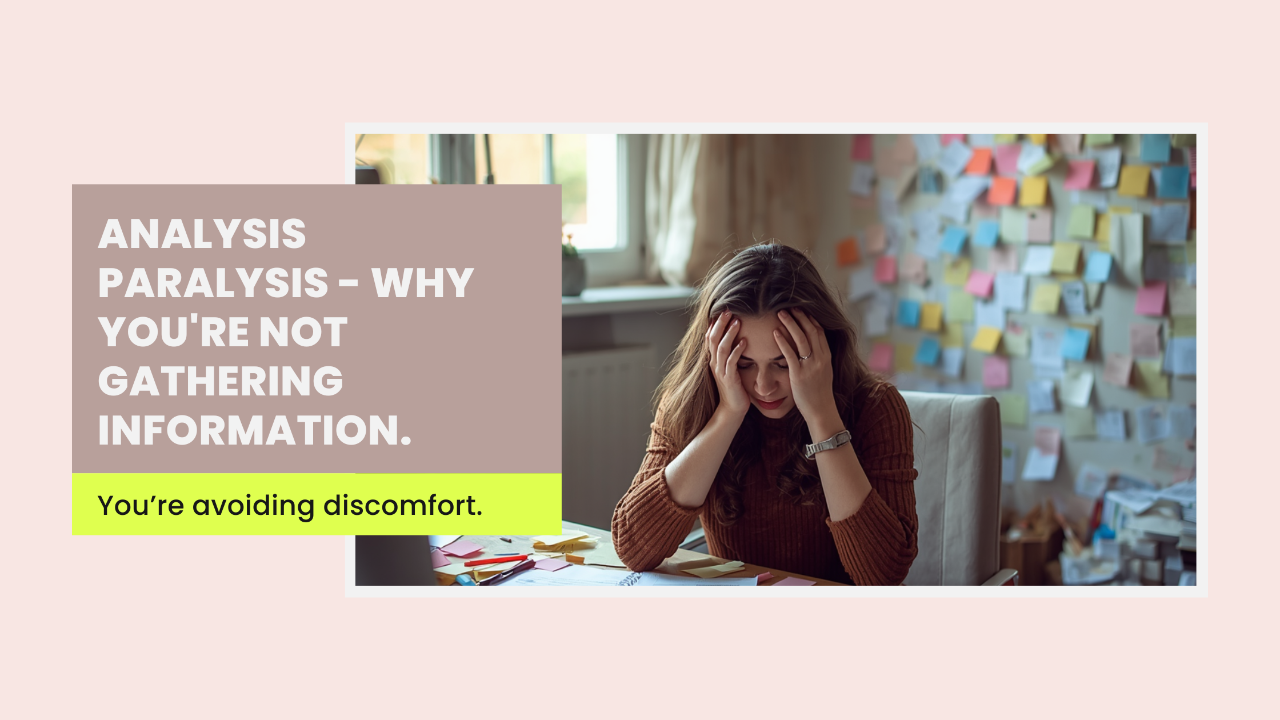
The research loop is a safety strategy. Here's how to break it.
Quick Answer
Analysis paralysis is what happens when seeking more information becomes a way to avoid the discomfort of committing to a choice. You're not being thorough. Your nervous system is using research as a delay tactic against the moment of risk. The information isn't the problem. The threat of being wrong is the problem.
The reframe: more research won't help, because research isn't what you need. Your body needs to feel safe enough to choose.
The Research Loop You Keep Getting Stuck In
You read three articles, watched two videos, asked in two Facebook groups. You have a spreadsheet. You have opinions from people you respect who disagree with each other. You have more information than you started with.
And you still haven't decided.
Each new piece of information feels like progress. But the decision keeps moving. There's always one more thing to check, one more perspective to consider, one more angle you haven't covered yet.
The research isn't what's missing. Safety is what's missing. Until your nervous system believes it's okay to be wrong, no amount of information will make the decision feel safe enough to make.
What Analysis Paralysis Actually Is
Analysis paralysis is a nervous system safety strategy: using the act of gathering more information to delay the moment of commitment and the perceived risk that comes with it. It looks productive. It generates a sense of progress. It is not actually moving you toward a decision — it's protecting you from one.
Signs you're in analysis paralysis, not genuine research:
- You've been in research mode for more than two weeks on the same decision
- You're asking the same questions in different places hoping for a different answer
- You have enough information to decide — you just haven't
- The new information you're seeking wouldn't actually change your decision
- You feel more anxious after researching, not less
What It's Costing You
| Cost Category | Specific Impact | Business Effect |
|---|---|---|
| Time | Hours in research that doesn't move the decision | Time that could have gone to execution |
| Energy | Carrying the open loop of an undecided question | Background cognitive drain |
| Momentum | Decisions deferred = actions deferred = progress stalled | Business moves slower than it needs to |
| Confidence | Every loop reinforces "I can't trust my own judgment" | Self-trust erodes over time |
How to Break It
Way 1: Identify the Real Question Underneath
Most analysis paralysis is covering a question that's much simpler and scarier than it appears. The surface question is "which marketing strategy should I use?" The real question might be "what if I choose wrong and it doesn't work and I find out I'm not cut out for this?"
The practice: Ask yourself: "If I already knew the answer, what would I do?" Then: "What am I afraid will happen if I do that?" The second answer is usually the real question — and that's what you're actually trying to research your way around.
Way 2: Set a Hard Research Deadline
Open-ended research expands to fill available time. "I will make this decision by Thursday" isn't pressure — it's a structure that forces your nervous system to stop scanning indefinitely. Before the deadline: identify what specific information would actually change your decision. If it's not available, that's also information: you're deciding without certainty. That's always going to be true.
Way 3: Separate "Good Enough" From "Perfect"
Analysis paralysis is often perfectionism's closest relative. The implicit goal is to find the objectively correct answer — the one that can't be wrong. That answer doesn't exist in business decisions. Every choice carries risk.
Good enough means: this is the best decision I can make with the information I currently have, knowing I can iterate. That's not settling. That's how every successful founder actually operates. The ones who look decisive aren't more certain — they're more comfortable with uncertainty.
Way 4: Make the Decision Reversible in Your Mind
Many decisions feel permanent that aren't. Write: "If I choose X and it doesn't work, I can [specific reversal step] within [timeframe] at a cost of [actual cost]." Most of the time, the reversal is cheaper and faster than the anxiety of not deciding.
Way 5: Regulate Before the Research Session
Research done in an activated state generates more activation, not less. You read something that contradicts your current direction, your threat response activates, you seek more information to reduce the activation, that information introduces new uncertainty, repeat.
Do 5 minutes of regulation before any research session. Cold water, slow breathing, a short walk. Then set a 30-minute research limit.
Way 6: Use a Two-Option Forcing Function
When there are too many options, limit yourself to two. Reduce to two concrete options. Set a 48-hour deadline. Choose between those two. If neither is right, that's also information — and you can find a new pair.
Way 7: Address the Root of the Loop
Chronic analysis paralysis — the kind where you do this across every major decision, consistently — usually points to something deeper. A pattern around needing to be certain before acting. A history of being wrong in ways that had significant consequences.
Daily regulation practices help this over time. But the pattern underneath usually needs direct work.
Ready to Break the Loop?
If analysis paralysis keeps stalling your business, the 2-Minute Reset addresses the nervous system pattern underneath it — not with research frameworks, but with the foundation that makes choosing feel easy.
The Questions Founders Actually Ask
Q: How do I know when I have enough information?
A: When the next piece of information you'd seek wouldn't actually change your decision. If you already know what you'd do — you have enough information. The research continuing past that point is avoidance.
Q: What if I decide and I'm wrong?
A: You iterate. The question worth asking is: "Is this decision recoverable?" Almost all business decisions are. The cost of the wrong decision is almost always lower than the accumulated cost of not deciding.
Q: Is it okay to ask for opinions?
A: Yes — one or two people whose judgment you actually trust, asked once. Not an open poll. Not multiple rounds of conflicting opinions. One trusted source, then you decide.
What Changes When the Loop Breaks
- Decisions that took months take days. Not because you're less careful. Because you're not avoiding them.
- Your judgment improves. Decisions made from a clear, regulated state tend to be better than ones made after weeks of anxious research.
- Business momentum returns. Actions that were waiting on decisions start happening. Progress compounds.
- Self-trust builds. Each decision you make and survive is evidence that your judgment is reliable.